
TRAVEL MOTOR REPLACEMENT
To replace an excavator travel motor accurately, identify whether the requirement is the hydraulic motor section or the complete final-drive assembly. Then compare the full reference, machine model, mounting flange, hydraulic ports, shaft connection and control configuration.
Travel motor, reduction gearbox and complete final drive are different quotation scopes.
Record every character and suffix on the motor or assembly reference.
Ports, flange, shaft, brake and speed-change controls must match.
When one side remains installed, compare its reference and configuration with the failed side.
Excavator travel motor and final drive example
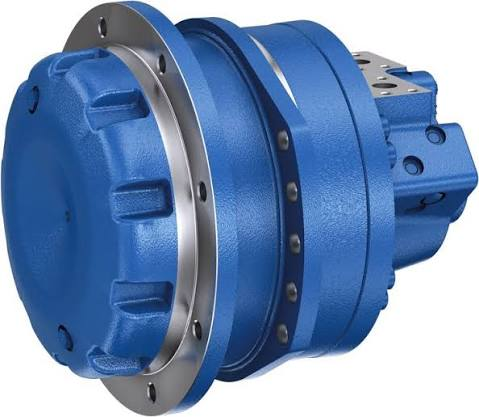
How to identify an excavator travel motor
- Send the excavator brand, model and serial number.
- Photograph the travel motor or final-drive label clearly.
- Show the motor side, gearbox side, mounting flange and hydraulic ports.
- Record the main, drain and speed-change connections.
- State whether the gearbox is reusable or a complete assembly is required.
Important physical and hydraulic checks
- Motor displacement and model reference
- Mounting-flange size and bolt-hole pattern
- Output shaft or spline connection to the gearbox
- Main port, drain port and control-port positions
- Parking brake and two-speed travel arrangement
- Attached valves, sensors or fittings included in the quotation
Travel motor versus complete final drive
A hydraulic travel motor converts oil flow into rotary power. The reduction gearbox converts that speed into track-driving torque. A complete final drive combines both. If the failure has not been separated between the motor and gearbox, request an inspection before ordering a single section.
Fault information that helps the enquiry
Uneven travel, weak drive, external leakage, abnormal noise, overheating or inability to hold on a slope can help describe the problem. However, similar symptoms may also involve the main pump, control valve, swivel joint, hoses, brake or gearbox. Diagnosis and part identification should be treated as separate steps.
Pre-order checklist
- Quoted component scope is written clearly
- Part number and machine serial data have been compared
- Ports, flange and shaft connection are documented
- Brand, condition and included valves are stated
- Unresolved fitment points are recorded before payment
Request a travel-motor quotation
Send the full motor or assembly reference, machine model, serial information, clear photos, quantity and destination country.
Browse travel and drivetrain parts Read the final-drive guide Review quality checks Request a quotation
Excavator travel motor FAQ
Can the left and right travel motors be different?
Many machines use the same configuration on both sides, but this should be verified from the references and machine data rather than assumed.
Can I replace only the hydraulic motor?
Yes when the gearbox is serviceable and the motor-to-gearbox interface is confirmed. The repair workshop should define the failed scope.
Is a photo of the installed unit enough?
It helps, but the label, machine serial data and interface details provide stronger identification evidence.
When the travel-motor label is damaged
If the label cannot be read, send the machine serial information and a complete photo sequence before removing the unit. Include the motor-side valve block, hydraulic hoses, drain and speed-change connections, mounting flange, motor-to-gearbox interface and the opposite-side unit when available.
Measurements and photos can narrow the candidates, but they do not automatically prove internal displacement, brake configuration or interchangeability. Any identification based on incomplete evidence should remain clearly marked as pending confirmation.
Installation records worth keeping
Before installation, photograph the received label, ports, shaft, flange and included valves. Record the hydraulic-system cleaning, filter replacement, oil condition and any gearbox oil added. After commissioning, note operating pressure or performance observations available from the workshop. These records improve traceability and make any later technical review more useful.
Keep the failed unit available until identification and commissioning are complete.